Does the Hormuz Crisis Show China Has Escaped the “Malacca Dilemma”?
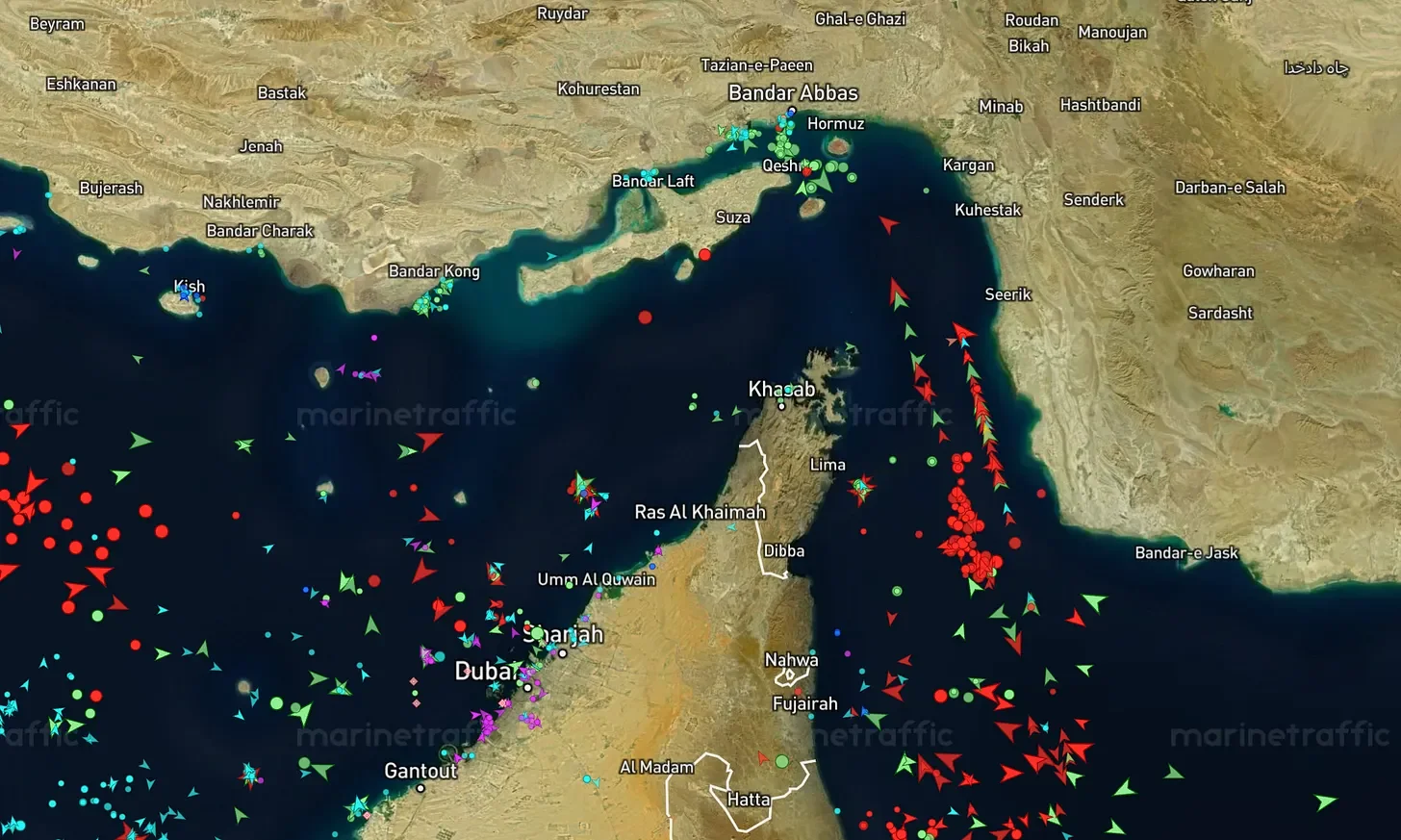
Satellite image of the Strait of Hormuz (Source: Marine Traffic)
Over two decades after Beijing first raised concerns over maritime chokepoint vulnerability, China’s efforts to mitigate the Malacca dilemma are now being tested in the Hormuz crisis.
Author: Owen Au
Following the war in Iran, Tehran has continued to block maritime traffic through the Strait of Hormuz, a narrow waterway through which roughly 20 percent of global oil consumption passes. The consequences of such a blockade are so severe that the tactic has long been described as Iran’s “nuclear option”.
Many analysts note that Asian energy markets are particularly vulnerable to disruptions in the Strait. It is estimated that more than 80 percent of the energy shipments transiting Hormuz are bound for Asia.
As the world’s largest energy consumer and importer, China is hardly immune to the shock. In fact, more than 40 percent of China’s imported oil still passes through the Strait. Nevertheless, Beijing has so far appeared relatively calm, responding mainly with routine calls for de-escalation in the region.
The crisis at Hormuz also brings to mind the decades-old “Malacca dilemma”, a concept that captures China’s vulnerability to maritime chokepoints. It therefore raises the question: has China finally managed to overcome it?
The “Malacca Dilemma”
In November 2003, then-General Secretary of the Chinese Communist Party (CCP), Hu Jintao, expressed concern over China’s reliance on sea lines of communication (SLOCs) passing through the Strait of Malacca for energy imports. The issue later became widely known as the “Malacca dilemma”.
In reality, the dilemma extends far beyond a single strait. It reflects China’s broader dependence on maritime trade routes and its vulnerability to a handful of critical chokepoints. The problem is therefore one of systemic maritime geography rather than any individual passage.
This strategic concern has been widely discussed within China. In 2011, a Senior Captain of the People’s Liberation Army Navy (PLAN) published On Maritime Strategic Access (海上战略通道论), which systematically analysed the strategic importance of SLOCs to China’s national interests. She argued that as China’s external economic dependence continued to deepen, safeguarding maritime strategic routes had become “a major strategic concern of the Party and the State”.
The blockade of Hormuz therefore resonates with longstanding anxieties within the Chinese leadership. Vulnerabilities in energy supply chains have long shaped Chinese strategic thinking, including concerns that disruptions could complicate wartime planning in a potential Taiwan contingency, a predicament reminiscent of the energy constraints faced by Japan during the Second World War.
Mitigating the Dilemma
To mitigate the risks posed by maritime chokepoint vulnerabilities, China has spent the past two decades pursuing several strategies.
First, Beijing has expanded its strategic petroleum reserves. In 2007, China’s State Council established the National Petroleum Reserve Centre (国家石油储备中心) to manage the country’s strategic petroleum reserve (SPR) system. Since then, reserve capacity has steadily expanded. The Energy Law (能源法), enacted in 2025, further integrated government and commercial oil stocks under a unified national reserves framework.
China has also accelerated stockpiling in response to geopolitical instability. According to the Wall Street Journal, Beijing significantly increased reserve purchases in early 2025 following the escalation of the war in Ukraine. By the time Iran’s blockade disrupted global supply, China was estimated to hold more than 1.2 billion barrels of crude oil, sufficient to cover imports for over one hundred days.
Second, China has diversified its sources of energy imports. In particular, Beijing capitalised on the geopolitical fallout from Russia’s full-scale invasion of Ukraine, purchasing large volumes of discounted Russian crude under Western sanctions. Much of this oil reaches China through routes that bypass traditional Indo-Pacific chokepoints. As a result, Russia overtook Saudi Arabia in 2023 to become China’s largest supplier of crude oil, accounting for roughly 20 percent of Chinese imports. Today, nearly half of Russia’s crude exports are destined for the Chinese market.
Third, and perhaps most significantly, China has sought to reduce the strategic importance of oil through energy transition and electrification. Xi Jinping has repeatedly emphasised that “the bowl of energy must be held firmly in our own hands” (能源的饭碗必须端在自己手里), framing energy security as a core national priority.
Renewable energy and electrification are central to this strategy. According to the China Electricity Council (中国电力企业联合会), China’s electrification rate in final energy consumption reached 28.8 percent by 2025 and is projected to rise to 35 percent by 2030. Much of this growth will be driven by renewable energy, a sector in which China already holds a dominant global position.
The Problem Remains
China’s relative resilience to the Hormuz disruption suggests that these measures have improved its ability to manage supply shocks. Nevertheless, it would be an overstatement to suggest that the Malacca dilemma has been resolved.
The structural vulnerability associated with maritime chokepoints remains intact. China’s economic growth has long been driven by exports of manufactured goods, and export-led development shows little sign of slowing despite tariffs imposed by the United States. As with most global trade, the majority of these flows depend on maritime transport. According to the United Nations Conference on Trade and Development, roughly 80 percent of world trade by volume is carried by sea.
China’s pursuit of supply-chain autonomy does not diminish this dependence. On the contrary, efforts to expand China’s industrial and technological capacity often deepen its integration into global markets. With domestic consumption still relatively weak, maintaining access to overseas markets remains vital to China’s economic security, and those markets are reached largely through SLOCs.
Paradoxically, China’s ambition to dominate global supply chains frequently requires deeper participation in international commodity flows. For example, although China occupies a dominant position in the global supply chain for critical raw materials, this dominance stems primarily from its technological and industrial advantages in midstream and downstream processing and manufacturing rather than from abundant domestic resources. As a result, China remains the world’s largest net importer of many critical minerals.
This dynamic is reflected in China’s evolving security doctrine. Recent defence white papers increasingly emphasise the protection of the “industrial supply chain” (产业供应链) and the safeguarding of China’s “overseas interests” (海外利益) as key pillars of national security.
Looking Ahead
China will likely draw lessons from the Hormuz crisis and accelerate its strategies of energy diversification and transition as part of its broader pursuit of supply-chain autonomy. Some analysts believe the disruption could further deepen China’s energy partnership with Russia, whose crude exports already account for a significant share of Chinese imports and bypass several Indo-Pacific chokepoints.
Yet resilience should not be mistaken for resolution. China has not escaped the Malacca dilemma. While diversification, stockpiling, and electrification may reduce the immediate risks of energy disruption, the country’s continued dependence on maritime trade and global supply chains ensures that maritime security will remain a persistent strategic concern for Beijing.
This article was originally published in China Maritime Watch.